


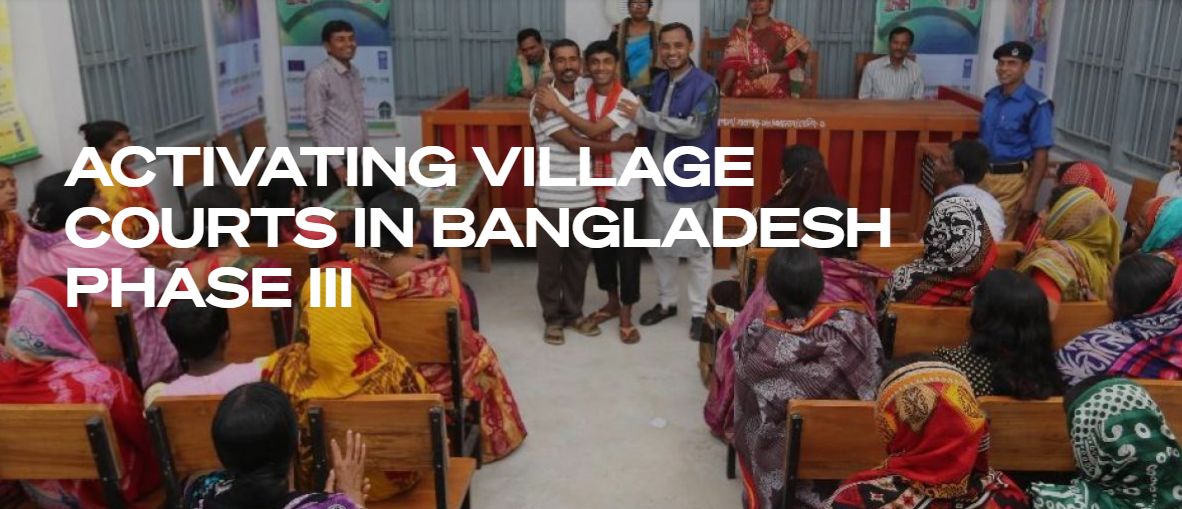
Activating Village Courts in Bangladesh – Phase III: Ensuring Justice at the Doorsteps
Activating Village Courts in Bangladesh – Phase III: Ensuring Justice at the Doorsteps
Posted by Rumel 27 July 2025
Introduction
Bangladesh’s formal judiciary is burdened with an overwhelming backlog of nearly 4 million cases, making it increasingly difficult for rural citizens—especially women, ethnic minorities, and low-income groups—to access justice. Recognizing this gap, the Government of Bangladesh (GoB) introduced the Village Court Act, 2006, with the aim of decentralizing justice by offering community-based, quasi-judicial dispute resolution.
However, the system never fully matured until the launch of the Activating Village Courts in Bangladesh (AVCB) project. With Phase I and II successfully piloted and implemented between 2009 and 2022, the AVCB Phase III initiative is now scaling up across the country—working to provide justice at the grassroots level to nearly 89 million rural citizens.
Project Objectives
The overall objective of the AVCB Phase III project is to increase access to justice for people in rural Bangladesh, especially for women, ethnic minorities, and disadvantaged populations.
Specific objectives include:
-
To improve the capacity of local justice actors to meet community justice needs by establishing and maintaining well-functioning village courts.
-
To empower rural citizens, particularly women, the poor, and marginalized groups, to utilize Village Courts for resolving minor civil and criminal disputes.
These objectives ensure the project goes beyond system reform, aiming for social inclusion, gender equality, and legal empowerment at the community level.
Why Village Courts Matter
Village Courts (VCs) are a vital component of local justice delivery, offering a faster, simpler, and more cost-effective solution to minor legal conflicts. They serve as a bridge between traditional mediation and the formal justice system, reducing the pressure on overburdened courts and bringing justice closer to citizens’ homes.
AVCB Phase III: Expanding Justice Access Nationwide
Led by the Local Government Division (LGD) of the Ministry of Local Government, Rural Development and Cooperatives (MoLGRD&C), AVCB Phase III focuses on:
-
Activating Village Courts in 3,041 new Union Parishads (UPs)
-
Sustaining operations in 1,416 previously activated VCs
-
Targeting approximately 89 million rural citizens
-
Ensuring government ownership and project sustainability beyond 2027
The project is supported by a significant resource mobilization of US$ 47.01 million (EU: 28.64M, GoB: 18.64M), reinforcing long-term commitment from both national and international partners.
Core Areas of Work
🔹 Capacity Building – Training UP chairpersons, secretaries, panel members, and Village Court assistants.
🔹 Mainstreaming with GoB Staff – Embedding court operations into government systems.
🔹 Legal and Policy Framework – Operationalizing 2016 Village Court Rules and ongoing amendment of the 2006 Act.
🔹 Digitalization – Introducing digital tools for efficient case tracking, reporting, and monitoring.
🔹 Monitoring & Evaluation – Enabling GoB to track VC performance using measurable indicators.
🔹 Community Awareness – Raising public understanding of how and when to access VCs.
🔹 Performance Maintenance – Supporting and monitoring existing courts from AVCB-I and II.
Impact and Achievements
The results so far highlight the project’s significant contribution to inclusive and participatory local governance:
✔ 1,079 Union Parishads activated with functioning Village Courts
✔ 2,36,868 disputes resolved, 30% involving women and vulnerable groups
✔ 82% resolution rate, with an average of 25 days per case
✔ Only BDT 233 (US$ 2.7) spent on average per user for court fees, travel, and food
✔ 91% user satisfaction
✔ Women’s participation in decision-making increased from 2% (2017) to 15% (2021)
✔ 11,669 cases referred from District Courts, easing pressure on higher courts
✔ BDT 191.76 Crores recovered and distributed to petitioners—used for health (20%), family needs (39%), small business (27%), loan repayment (11%), asset purchase (3%)
Looking Ahead
With strong collaboration between the Government of Bangladesh, the European Union (EU), and the United Nations Development Programme (UNDP), AVCB Phase III is setting a powerful precedent for localized justice reform.
By empowering citizens and building trust in the justice system, this project is not just about resolving disputes—it’s about strengthening democracy, promoting gender equity, and ensuring no one is left behind in the quest for justice.
Conclusion
The Activating Village Courts in Bangladesh Phase III project is a transformative model for expanding access to justice in rural areas. By investing in capacity building, digital innovation, and inclusive legal empowerment, the project is shaping a future where justice is truly within reach—for every citizen, in every village.
52